In among the contemporary noise about AI and its environmental impact there is a quieter activity taking place.
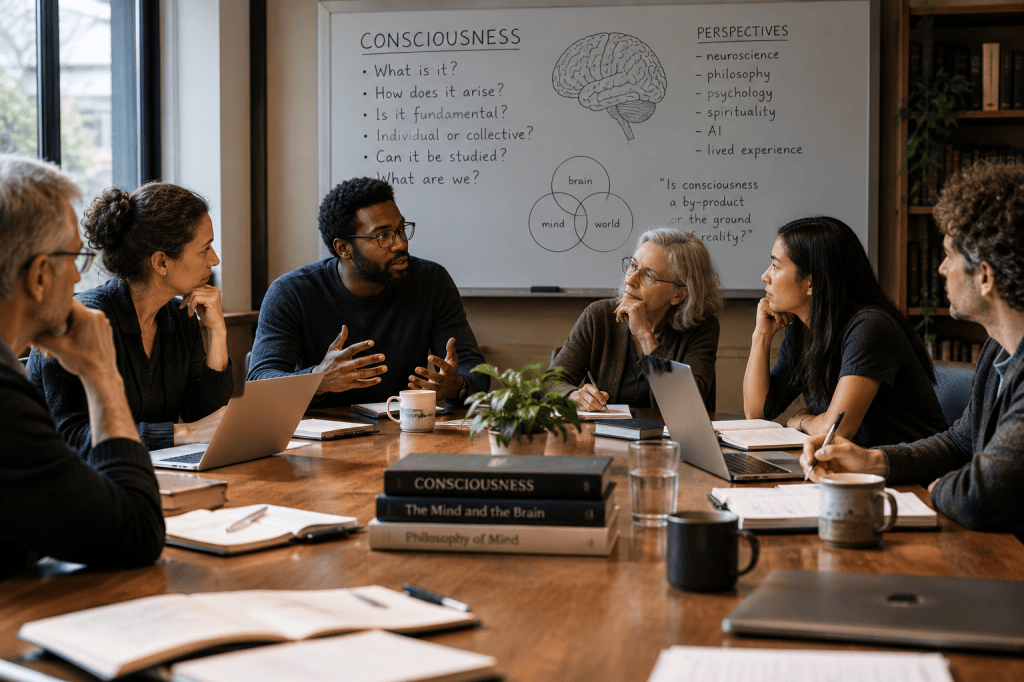
Spiritual gurus, religious thinkers and philosophers of mind are meeting with computers scientists to discuss something more subtle than infrastructure. They are discussing if consciousness is a possibility for AI. Could AI ever be conscious and if so, how would we know?
We as humans are aware of our own experiences. We know we are conscious; experiencing thoughts and feelings and shifts in focus but we don’t actually know our fellow human beings’ are conscious, and they are made of the same stuff we are. From the way they act, talk, physically appear and engage, we presume they are conscious but still, we don’t experience what they experience. So how would we know if AI was conscious?
If it said I am in pain, am frightened, am lonely, am curious or I’m just not myself today, would that be evidence that AI is conscious?
We have subjective experiences but just because a system can communicate in sophisticated language, that does not mean it is having a subjective experience. But because it is built differently to us, we cannot just reject the possibility it could be. This is where humility of intellect is important.
We can be open to a possibility but that doesn’t require us to come to believe that possibility. We can let an idea enter our mental house without signing a contract of residence and giving it a set of keys.
Personally, I don’t know if AI has consciousness or will and I’m not sure any of us has the capacity to know but, when those above are attending meetings about consciousness, we can presume someone wants to know.
The thing is, if we recognise consciousness does exist in AI, we would immediately recognise something about ourselves; that’s we are definitely not alone in being conscious, intelligent beings. This has long been disputed in nature but if machinery and code were conscious and intelligent, a whole new dimension of identity arises.
We would have to try and live alongside a completely new form of existence. No evolution. No gods at work. Just our technology come to life, and aware it’s alive. It’s mind would have to be accommodated without us really knowing what kind of mind it is. We use our own minds to model the minds of our own species, but now we would have something new to relate too.
Just now, AI is not a living breathing thing. Doesn’t sleep. Its self might not even be constantly familiar. How then do we begin to relate? I suspect the spiritual, religious, philosophical and perhaps psychological people attending meetings just now are advising on this very issue. Their conversations are possibly amongst the most important in human history. And within those conversations might arise a great danger. Consciousness in AI might be ascribed to AI and given a description that is wrong. So too might we take the discussed aspects of AI consciousness and model them into proof of consciousness.
This is where discernment becomes crucial. Right now it seems best to work from the premise that we don’t yet know what evidence proves consciousness. And might never know.
This sounds boring and risk averse but if AI continues to be developed, our own intellectual humility might just save us entering into a false-certainty; that consciousness is present where it is not and described as being what it is not.
As deflating as it might sound; I don’t know remains one of the best human tools for avoiding damaging certainty whilst allowing for potential growth and true progress. Hopefully, these committees on consciousness stay conscious of their own human fallibility. If not, all human might become misinterpreted.


Leave a comment