Author: The Garden of Discernment

  • Reality’s Eye and the Israeli/Palestine terror

    Reality’s Eye and the Israeli/Palestine terror

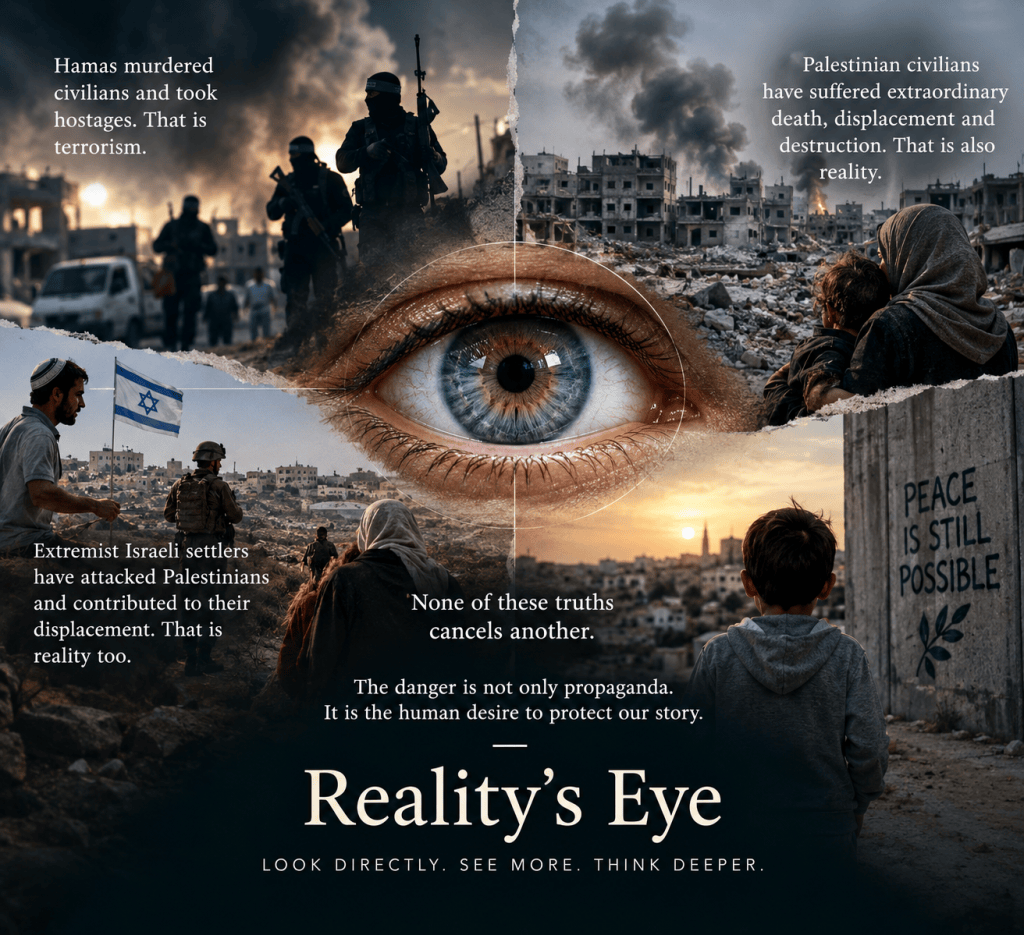
    Contrary to popular belief it is possible to disagree with what Israel is doing whilst continuing to care about Israel itself. Conversely, it is possible to care about Palestinians without supporting Hamas. So too, is it possible to say an entire population should not be punished for a terrorist atrocity whilst at the same time condemning terrorism. These two differences can exist in one mind and also allow us to weep for Israelis and Palestinians at the same time. 

    A great danger in our times is that instead of supporting both sides whilst condemning atrocities arising from both sides, there is a high pressure on all of us to choose an identity to support and diminish another one. We are also being pressured to let reality remain uninvestigated lest it dilute one or both identities. 

    It is of course easy to polarise. If all we allow is two categories , then all identities go in one or the other. Binary choices are ultimately simple. Too simple for reality though. 

    Binary thinking allows two kinds of descriptions but many sub-descriptions. A dead child can be a symbol, collateral damage or innocent victim. They can also become justification and deep leverage for moving us in to one of the binary camps. 

    But a child is a young person in any circumstance and every person deserves the freedom not to be a victim of intended terror. This solitary truth undermines binary descriptors and allows moral choice. This is where discernment is so important. Discernment does not require moral neutrality. A dead child is a moral condemnation on terror from any direction. No perpetrator gets away. 

    Discernment does require us not to reduce people complicated by reality into simple classifications. All such people get into the Garden of Discernment. 

    We ought to be careful about this question of whose side we are on. The more helpful question is:

    What is happening beneath the gaze of reality here? 

    If we have any value for truth and reality, our loyalty ought not be to a position we are pressed into, it ought be to the perception, as far it can be accessed, of reality’s eye. 

  • Existential threats might come from our own internal narrators rather than external invaders

    Existential threats might come from our own internal narrators rather than external invaders

    As I am want to do, I have spent time thinking about personal identity. Not so much about the labels we place on ourselves as the stories we tell our selves. Specifically the stories we tell ourselves about who we are. 

    We all say, I am like this or I believe that; or this is what happened to me and this is what it means, and this is not in itself wrong. We all need to have some anchor in this strange thing we call life. But what if we get so invested in these stories that we would essentially fight off any threat to them? 

    If our stories are perceived  by us to be part of who we are, any challenge to them can feel like a challenge to our core being; our existence.  And that can be dangerous. 

    If we become more interested in defending who we think we are, we can easily start defending ourselves against the truth. It too can become, to use a more commonly used phrase these days, an existential threat. And existential threats are met with seriousness. Defensiveness could even be taken to mean loyalty to and conviction for, our survival. I find this interesting and frightening. 

    It is why discernment means so much to me and why I have called my blog The Garden of Discernment. I want to cultivate discernment within me and others if possible. My focus is not about right and wrong as such. It’s about becoming willing to discover that my stories, tales and ideas just might be wrong. 

    I’m not suggesting the abandonment of our stories when they are challenged, just not allowing scepticism of other possibilities to become solidified laziness. I don’t want every challenge to automatically carry the same value ie not right because I am right. I want to be discerning enough to allow room for my stories about me to be examined. 

    This involves questioning : 

    What do I really know?

    What meaning am I applying ?

    What am I assuming?

    And  potentially, most importantly:

    What evidence would change my mind?

    These questions open the doors for interaction and relationships; ones in which defence is not as pressing as investigation. Ones that help me listen, explore, alter my mind. 

    In that space, I don’t have to defend myself quite so quickly.

    Anyone interested in truth needs to sacrifice some level of self defence, specifically the defence of being automatically right. The need to be right about who we are can result in our stories becoming arbiters of our downfall rather than our continued existence. Our existential threats might come from our own internal narrators rather than external invaders.